Project Topic: Fibonacci Numbers in Nature
Introduction
The Fibonacci Sequence is an intriguing pattern in mathematics that appears in various aspects of our daily lives. We see it in architecture, art, nature, and even people! Looking into this sequence we see that it is defined recursively. This means that it is defined by using its previous terms until a specified base condition is met. In this instance, each term in the sequence is the sum of the two preceding terms. The sequence begins with 1, 1 and progresses as 2, 3, 5, 8, 13, and so on infinitely. This fascinating sequence also has multiple connections to the golden ratio, also known as phi, making it a cornerstone of aesthetics and functionality in both man-made and natural systems. By exploring the mathematics behind it, this project aims to bring to light both the beauty and utility of the Fibonacci Sequence.
History and Background
The Fibonacci Sequence’s history is almost just as interesting as the sequence itself. We can start
by talking about Leonardo of Pisa, also known as Fibonacci. He was the one to introduce the
sequence to everyone in his book Liber Abaci (1202). In this book, he proposed a problem about
rabbit reproduction, which helped him generate the sequence. However, long before Fibonacci,
Indian mathematicians such as Pingala explored similar patterns in the Sanskrit prosody.
The sequence is also distinctly connected to the golden ratio. This relationship was first
recognized by ancient Greek mathematicians. They used the number phi to define ideal
proportions in architecture. One famous landmark that they used phi to construct was the
Parthenon. Over time, they began to use this concept of phi in other areas beyond art and
geometry. One of which was modern science, where the Fibonacci numbers revealed truths about
growth and efficiency in nature.
The Mathematics in the Sequence
The Fibonacci Sequence is a recursive formula that follows the pattern below:
F(n)=F(n-1)+F(n-2)
with F(0)=0, F(1)=1
This formula generates a series with profound mathematical properties. For example, the ratio of consecutive terms approaches the golden ratio phi which is equal to 1.618…., a phenomenon known as the convergence property. The sequence also appears in Pascal’s Triangle, with sums of diagonals producing Fibonacci numbers, highlighting its deep connections to combinatorics and algebra.
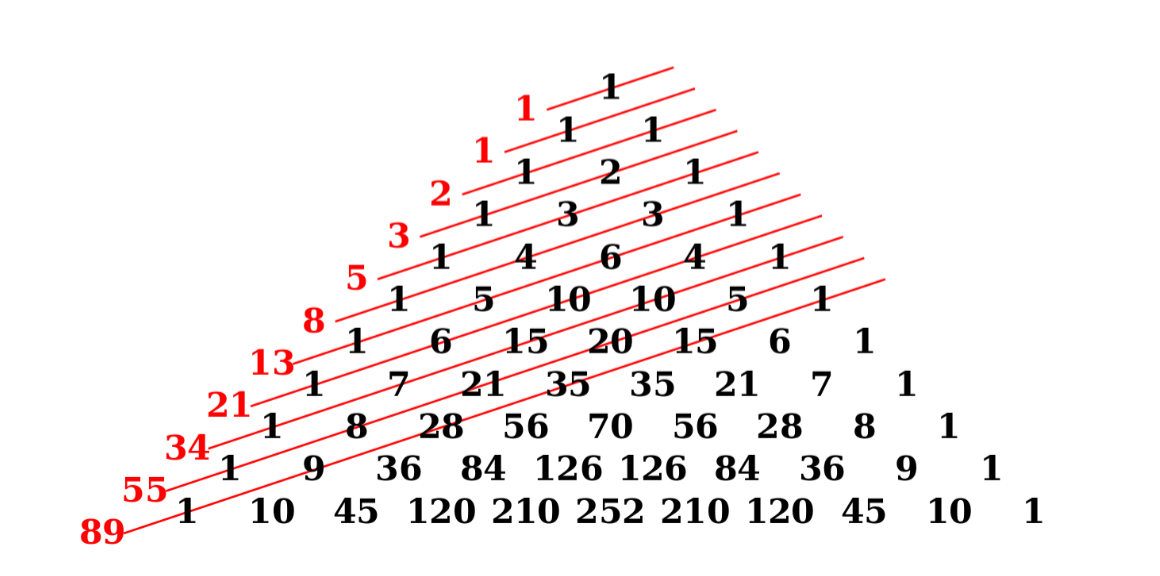
Further, Fibonacci numbers exhibit modular patterns and divisibility properties, making them a
rich field for number-theoretical research. For example, every nth Fibonacci number is divisible
by , an insight that has implications for cryptography and coding theory. The versatility of this
sequence reflects the power of mathematical abstraction to help us discover universal principles.